
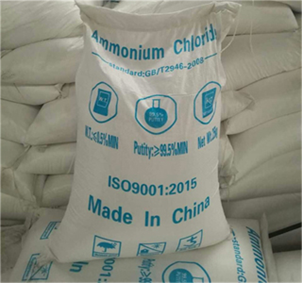
Appearance: White powdered crystals
Grade: 99.5%min tech grade
Package:25 kg bag
CAS NO.: 12125-02-9
Ammonium chloride, chemically represented as NH4Cl, is a white crystalline salt that is highly soluble in water. It is commonly found in volcanic regions and is produced naturally by the reaction of ammonia with hydrogen chloride in the atmosphere. Industrially, ammonium chloride is synthesized by neutralizing hydrochloric acid with ammonia. It has various applications, ranging from medicine as a expectorant and laxative, to use in photography as a developer, and in metalworking as a fluxes to prevent oxidation during welding. In addition, it serves as a nitrogen source in fertilizers and as a component in the batteries of thermal power plants for heat storage.
Medical Applications
Ammonium chloride is used in medical preparations as a urinary acidifier. It aids in the treatment of metabolic alkalosis by increasing the acidity of urine, thereby helping to restore the proper ph balance in the body.
Nutritional Role
As a source of nitrogen, ammonium chloride is utilized in fertilizer blends. Nitrogen is a key nutrient for plant growth, and ammonium chloride provides this essential element in a form readily usable by plants.
Flux In Metalworking
In the field of metallurgy, ammonium chloride serves as a flux during soldering, brazing, and welding. It cleans metal surfaces by removing oxides and other impurities, improving the bond between metal pieces and preventing oxidation during the heating process.
Photographic Developer
In photography, ammonium chloride is used as a developing agent. It helps in the development of silver halide crystals into metallic silver, which forms the image on the film or photographic paper.
Acidic Flame Retardant
Due to its acidic nature, ammonium chloride can be used as a flame retardant. It releases hydrochloric acid upon heating, which deactivates the flames by neutralizing the alkaline nature of the burning material.
Cost-effective
Lastly, ammonium chloride is a cost-effective chemical that is widely available and easy to produce. Its affordability combined with its multiple uses makes it a popular choice for various industries.
Ammonium chloride (NH4Cl) is a compound consisting of ammonium ions (NH4+) and chloride ions (Cl-). It is commonly found in nature and produced industrially for various applications. While there is essentially only one type of ammonium chloride in terms of chemical formula, there are variations in its purity, form, and intended use, which can be categorized based on these factors. Ammonium chloride can be purchased in different purity grades. Technical grade ammonium chloride may contain impurities and is typically used for agricultural or industrial purposes where high purity is not essential. Analytical reagent (AR) grade, on the other hand, has a higher purity level and is used in laboratories for analytical experiments where precise chemical composition is required. Pharmaceutical grade ammonium chloride is purer still and is used in medical preparations, such as expectorants. Ammonium chloride can exist in various physical forms, such as granules, flakes, or powder. These forms are chosen based on the ease of handling and application. For example, granular ammonium chloride is often used in fertilizers because it disperses easily and can be applied directly to soil without significant dust. In laboratory settings, ammonium chloride is used primarily as a source of hydrogen ions (protons) in titrations or as a control in buffering solutions. Here, the specific form (e.g., granules, powder) might depend on the ease of measurement or solubility required for the experiment at hand.
Dry Conditions
Ammonium chloride should always be kept in a dry environment. Excess humidity can cause the compound to clump or dissolve, reducing its flowability and making handling more difficult. Ideal relative humidity levels should be maintained below 50% to minimize moisture uptake.
Airtight Containers
The material should be stored in airtight containers made of plastic or glass. These materials do not react with ammonium chloride and provide a good barrier against environmental factors. Avoid using metal containers, as some metals might react with ammonium chloride.
Temperature Control
Maintaining a consistent temperature within the storage area is important. Extreme temperatures can promote the degradation of ammonium chloride or cause condensation on the container walls, leading to moisture ingress. Optimal storage temperatures typically range between 15°c to 25°c (59°f to 77°f).
Separation From Other Chemicals
To prevent cross-contamination, ammonium chloride should be stored separately from incompatible materials. This includes acids, oxidizing agents, and combustible substances. A material safety data sheet (msds) will provide guidance on compatible and incompatible storage conditions.
Ventilation
While ammonium chloride itself is non-volatile, proper ventilation in the storage area is still recommended to disperse any vapors or dust that may be generated during handling. This is particularly important in laboratories or industrial settings where the compound is frequently used.
Regular Inspection
Regular inspections of storage areas and containers should be conducted to monitor the condition of the ammonium chloride and the integrity of the storage facilities. Check for signs of container damage, leaks, or any indication that the stored material may be degrading.



Medical Industry
One of the most common applications of ammonium chloride is in the medical field. It acts as a urinary acidifier and is used to treat metabolic alkalosis, where the body's blood ph is too high. By acidifying the urine, ammonium chloride helps to correct the imbalance.
Fertilizers
In agriculture, ammonium chloride is used as a nitrogen source in fertilizers. Plants require nitrogen to grow, and ammonium chloride provides this essential nutrient in a form that can be readily absorbed and utilized by plants.
Metalworking
Ammonium chloride plays a crucial role in metalworking as a flux. When used during the soldering, brazing, or welding of metals, it removes oxides and other impurities from the surface of the metal, ensuring a clean joint and reducing the risk of corrosion.
Photography
In the field of photography, ammonium chloride is used as a developing agent. It participates in the development process by contributing to the formation of the image on photographic film or paper.
Firefighting And Flame Retardancy
Due to its acidic nature, ammonium chloride can be used as a flame retardant. When heated, it releases hydrochloric acid, which helps to suppress fires by neutralizing the alkaline nature of the burning material and inhibiting the fire spread.
Laboratory Reagent
Ammonium chloride is widely used in laboratories as a reagent for various experiments and procedures. It can serve as a buffer solution to maintain a stable ph in biological and chemical experiments. Additionally, it can be used to study cellular processes, such as ion transport across cell membranes.
Thermal Energy Storage
In the realm of renewable energy, ammonium chloride can be utilized in thermal energy storage systems. Its high melting point and latent heat of fusion make it an attractive candidate for storing thermal energy at elevated temperatures, which can then be released when needed.
Synthetic Chemistry
In the synthesis of organic compounds, ammonium chloride can act as a byproduct or a reactant. For instance, it can be involved in halogenation reactions to produce other ammonium salts or serve as a buffering agent to maintain a specific ph in chemical reactions.
Work Area Ventilation
Ensure that the area where you are using ammonium chloride is well-ventilated. If the work is performed in a closed environment, use local exhaust ventilation to prevent the buildup of dust and aerosols in the air.
Handling Precautions
Handle ammonium chloride with care to avoid creating dust. Use a spoon or scoop to transfer the chemical rather than pouring it, which can generate dust. If spills occur, clean them up immediately using the correct method outlined in the msds.
Incompatibilities
Be aware of the substances that are incompatible with ammonium chloride, including strong acids, oxidizing agents, and organic materials. Keep it separate from these substances to prevent dangerous reactions.
Storage Safety
Store ammonium chloride in its original container with the label intact. Never store it near food or edible items to avoid contamination. Keep it locked away from children and unauthorized personnel.
Emergency Procedures
Familiarize yourself with the emergency procedures for your workplace in case of an accident involving ammonium chloride. This includes knowing the location of safety showers, eye washes, and how to activate fire alarms and evacuate the premises.
Disposal
Dispose of unused or expired ammonium chloride according to local regulations and the instructions provided by the manufacturer. Do not pour it down the drain or dispose of it as regular waste.
Firefighting Measures
In case of a fire involving ammonium chloride, use appropriate firefighting equipment. Water spray or fog can be used for fires involving flammable solids, but do not use water jet directly as it may cause the material to scatter.
Hygiene Practices
Wash hands thoroughly before leaving the work area and avoid eating, drinking, or smoking in proximity to where ammonium chloride is used.
Purity Requirements
Determine the purity level necessary for your application. If you are working in a pharmaceutical or analytical chemistry setting, you will likely need highly pure ammonium chloride with a high percentage of the active ingredient. Grades such as technical, analytical, or pharmaceutical grade might be specified, each with varying degrees of purity.
Form And Granularity
Ammonium chloride comes in different physical forms, including granular, powder, and crystal. The form you choose should be compatible with your handling equipment and application method. Larger granules might be easier to handle and dispense, while finer powders might be necessary for certain reactions or processes.
Safety Data
Always review the safety data sheet (sds) for any chemicals you purchase, including ammonium chloride. This document will provide information on hazards, safe handling practices, and emergency measures in case of accidental exposure or spillage.
Intended Use
Reflect on the specifics of how you intend to use the ammonium chloride. Different applications might require different forms or purities. For example, if you are using it as a fertilizer, you might prioritize a form that is easily soluble in water. Conversely, if you are using it in a controlled chemical reaction, you might need a more precise granularity or purity level.
Direct Synthesis
One of the simplest methods for producing ammonium chloride is through direct synthesis, which involves combining elemental ammonia (NH3) with hydrogen chloride (HCl) gas. This reaction occurs at room temperature and results in the formation of solid ammonium chloride crystals. The process requires careful control of reaction conditions to ensure complete conversion and to prevent the formation of impurities. Direct synthesis is often used on a small scale for laboratory preparations.
Hydrochloric Acid Neutralization
A more common industrial method involves the neutralization of hydrochloric acid with ammonia. In this process, gaseous ammonia is bubbled through a solution of hydrochloric acid, resulting in the formation of ammonium chloride.


Byproduct Production
Ammonium chloride can also be obtained as a byproduct in the production of barium nitrate and ammonium sulfate. During the neutralization of sulfuric acid with limestone (calcium carbonate) in the Ostwald process for the production of nitric acid, ammonium chloride is formed as a byproduct along with calcium nitrate. This byproduct can be purified and crystallized to obtain pure ammonium chloride.
Other Methods
In some cases, ammonium chloride is synthesized by reacting ammonium salts with chlorine or chlorinated compounds. For instance, the reaction of ammonium sulfide with hydrochloric acid produces ammonium chloride and hydrogen sulfide.
What Are the Components of Ammonium Chloride
Ammonium chloride, denoted by the chemical formula NH4Cl, is a binary compound consisting of ammonium ions (NH4+) and chloride ions (Cl-). The ammonium ion is a cation derived from the ammonia molecule (NH3) by the addition of a proton (H+). This process, known as protonation, results in the transfer of a hydrogen atom from the acid to the base, forming the ammonium ion. The nitrogen in the ammonium ion has a formal positive charge due to the extra hydrogen atom, which gives the ion its characteristic positive charge. On the other hand, the chloride ion is the anion formed when chlorine (Cl2) gains an electron. This single electron addition converts chlorine, a diatomic molecule with zero net charge, into the chloride ion, which carries a single negative charge. The chloride ion is the simplest halide ion and is found in many different compounds, including ammonium chloride. The combination of these two ions, ammonium and chloride, creates the ionic compound ammonium chloride. The solid form of ammonium chloride consists of discrete NH4Cl units, with each ammonium ion being surrounded by six chloride ions and vice versa in a highly symmetrical arrangement. This structure is maintained through strong ionic bonds between the positively charged ammonium ions and the negatively charged chloride ions. In terms of its physical properties, ammonium chloride is a white crystalline solid at room temperature. It has a high solubility in water, which means it can readily dissolve in water to form aqueous solutions. When dissolved in water, ammonium chloride dissociates into its constituent ions, NH4+ and Cl-, which can then participate in various chemical reactions.
Can Ammonium Chloride Be Used as a Fertilizer?
Ammonium chloride, despite its common uses in medicine and various industrial processes, has indeed been considered as a potential fertilizer in certain agricultural contexts. While it is not a primary fertilizer choice due to its inherent characteristics, its application in soil management and plant nutrition is noteworthy. As a nitrogen source, ammonium chloride provides plants with a crucial nutrient required for growth and development. Nitrogen is a component of amino acids, proteins, and nucleic acids, and is essential for photosynthesis and the overall health of plants. However, the use of ammonium chloride as a fertilizer is not without its drawbacks. The chloride component of NH4Cl can accumulate in the soil and potentially cause issues related to soil salinity. High levels of chloride can lead to soil compaction, reduced soil fertility, and stress on plants, as excessive salt can disrupt the plant's osmotic balance and interfere with nutrient uptake. Despite these concerns, there have been instances where ammonium chloride has been applied to soil, particularly as a source of nitrogen in cold regions where other fertilizers might not be as effective or available. Its relatively high solubility allows it to be quickly taken up by plants, which can be beneficial in situations where rapid nitrogen uptake is needed. Moreover, ammonium chloride can play a role in soil pH management. Since it releases H+ ions when dissolved in water, it can contribute to slightly acidifying the soil, which may be desirable in soils with a high pH. However, caution must be exercised to avoid over-acidification, which can lead to nutrient imbalances and further stress on plants.
Ammonium chloride, often abbreviated as NH4Cl, has indeed been utilized historically as a component in fluxes for the purpose of soldering. Fluxes are essential substances in the soldering process, serving multiple functions to ensure a clean and reliable joint. They typically consist of a mixture of chemicals that perform tasks such as cleaning metal surfaces, removing oxidation, and providing protection against corrosion during heating. In the context of electronics and circuit board assembly, fluxes play a crucial role in ensuring a good solder connection. Ammonium chloride acts as a cleaning agent in these fluxes, as it can help dissolve oxides and other contaminants from the surface of the metal being soldered. Its ability to remove oxide layers is particularly valuable because oxides can impede the flow of the solder and weaken the bond between the metals being joined. Moreover, ammonium chloride can also serve as a wetting agent, enhancing the flow of the molten solder across the joint. This property is critical for achieving a strong and uniform connection. The presence of ammonium chloride in the flux helps the solder to flow smoothly and adhere well to the metal surfaces, which is essential for creating reliable electrical connections.
Ammonium chloride, with its chemical formula NH4Cl, plays a role in various industrial processes, one of which is textile production. Its use in this sector is largely attributed to its properties as a salt and its involvement in specific chemical reactions. In the dyeing process, ammonium chloride serves as an acid salt that can affect the pH of dye baths. Maintaining the correct pH is crucial for ensuring that dyes properly adhere to the fibers of textiles. Ammonium chloride helps to adjust the pH level, making it more acidic, which can enhance the dyeing process by improving the color fastness and brightness of the final product. Furthermore, ammonium chloride is utilized in the scouring of textiles, which is the process of cleaning and removing natural and artificial impurities from the raw material before it undergoes further processing. During scouring, ammonium chloride can help in the removal of oils, waxes, and other non-fibrous materials from the textile surface. Another application of ammonium chloride in textile production is in the finishing stages, where it may be used as part of a treatment to provide water resistance or flame retardancy to fabrics. These treatments often involve complex chemical reactions, and ammonium chloride can serve as a reactant or a catalyst to facilitate these processes. In the context of printing on textiles, ammonium chloride acts as a mordant. A mordant is a substance that fixes dyes onto fabrics, enhancing the vibrancy and longevity of the colors. By binding to the dye and the fabric fiber, ammonium chloride ensures that the printed design remains intact and does not fade or wash out easily.
Xiamen Ditai Chemicals Co., Ltd is a professional chemical company in China. Specializing deal and export various kinds of quality chemicals since 1997. The products Include industry chemical, Animal feed additive, Food additive, Agrochemical, Fertilizer, pharmaceuticals, water treatment and Minerals. Our management team has about 20 years of combined expertise meeting the needs of clients. We are proud our quality chemcials and service was approbated by the clients in the worldwide. Xiamen Ditai Chemicals Co., Ltd is an ISO9001:2008 certificated organization.


Q: What is ammonium chloride?
Q: What are the common uses of ammonium chloride?
Q: How is ammonium chloride produced?
Q: Is ammonium chloride flammable?
Q: Can ammonium chloride be used as a food additive?
Q: Can ammonium chloride be used as a fertilizer?
Q: Can ammonium chloride be used as a flux for soldering?
Q: Can ammonium chloride be used in dry cell batteries?
Q: Can ammonium chloride be used in medications?
Q: Can ammonium chloride be used in cleaning products?
Q: Can ammonium chloride be used in textile production?
Q: Can ammonium chloride be used in leather production?
Q: Can ammonium chloride be used in photography?
Q: Can ammonium chloride be used in fire extinguishers?
Q: Can ammonium chloride be used in cosmetics?
Q: Can ammonium chloride be used in agriculture?
Q: Can ammonium chloride be used in water treatment?
Q: Can ammonium chloride be used in the production of rubber?
Q: Can ammonium chloride be used in the production of glass?
Q: Can ammonium chloride be used in the production of ceramics?
